Pictorial Planet
Please become a patreon
Please become a Patreon of my work. For a small monthly donation (the price of a coffee) you get special videos just for Patreons, you support this site, and my youtube work. Just check out the two tiers (one coffee a month or two coffees a month) and decide what you might to donate. Just click the link below…
Geoffrey Crawley's FX-3 Solvent Developer
FX 3 Introduction
What we now call modern solvent developers began life in the late 1920s, early 1930s. This was when medium format and 35mm film became more popular with photographers.
D-76, the accepted standard for solvent developers, was formulated in 1927. Other companies designed similar developers, some with better speed, some with finer grain, all with varying degrees success but Kodak D-76 (copied by Ilford as ID-11) became the most popular and has remained the developer that all others are judged against.
It’s interesting to understand the reason these developers are called solvent developers. It’s through their use of chemicals that dissolve some of the silver in the image and subsequently reduce apparent grain.
Typically, these solvent developers used chemicals like:
- Thiocyanates
- Thiosulphates
- Sulphites
This list works down from the more powerful to least powerful silver solvents.
Kodak’s DK-20, for instance, is a very fine grain solvent developer and uses two solvent chemicals, thiocyanate and sulphite, in the formula to reduce film grain. This is a powerful grain reducing duo but with modern thin emulsion films can cause dichroic fog.

Covesea Lighthouse, Lossiemouth, Moray, Scotland FP4 Plus EI160 FX 3 1+1 6 minutes Ilford agitation 20C
*Tip - Removing Dichroic Fog
Dichroic fog is made of tiny silver particles precipitated on the surface of the emulsion. This fog particles reflect with colors of the spectrum when inspected giving it the name dichroic. It can be formed by solvent developers, especially if they have been re-used and are carrying a lot of previously dissolved silver. A short soak in a 2% acetic (vinegar) acid solution, such as fresh stop bath, can sometimes remove it. *
Nowadays, sulphite alone is most often used as the solvent for fine grain developers. Sulphite is milder in action and at normal solvent concentrations of up to 100g to 125g per litre rarely creates fog issues with most films.
As we saw with FX 1 developer, Crawley did extensive research on sulphite levels. This research showed that the solvent action of sulphite begins around the 45g per litre concentration. Below that level there is little dissolving and re-plating action (see tip below) but above 45g/ltr the solvent (and therefore grain reducing action) slowly increased.
*Tip - How Solvent Developers Work
Solvent developers might reduce grain through two avenues:
High sulphite levels, above 45g/ltr introduces “physical development” on top of chemical development. Physical development is where the sulphite dissolves the edges of the developing silver grains and then re-plates (or deposits) that dissolved silver elsewhere on the negative, on other silver halide crystals that either should not be developed at all or who’s latent potential to be reduced to silver is so deep they would not have normally been developed. This addition of a microscopic re-plated silver grain then encourages their development.
Sulphite also seems to reduce “grain clumping”, the primary cause for the appearance larger grain in negatives. Clumping is the buildup of developed silver around a seeded halide crystal. This is a form of infectious development where the action of developing one seeded site spreads to nearby halide crystals. Crawley said that with simultaneous chemical (regular) development and physical (sulphite) development a balance seems to form that reduces this clumping. A low alkalinity accelerator also helps to avoid clumping, he said, by providing conditions for slower even development. This would explain why a developer like Rodinal has larger observable grain - the high alkalinity causing clumping.*
Kodak’s D-76 became the standard for solvent developers; all others are compared to it. Companies either copied it or made small modifications in an attempt to improve on the formula (for example Adox MQ Borax). To Crawley, the D-76 formula was the most successful of developers in balancing, what he called, the speed-grain interlock. In Crawley’s opinion D-76 achieved the best balance between EI (film speed) and granularity for a film.
However, Crawley didn’t think D-76 made the most impactful and sharp prints from smaller formats and so when he added sharpness and micro-detail (both given by acutance and both ways to improve print impact) into the equation, what he now called the speed-grain-acutance interlock, D-76 fared poorly, trading the desirable properties of acutance and definition for grain reduction[1].
By immediately changing his formulation objective, that is, to improving the three-way interlock of speed-grain-acutance, Crawley knew he could improve upon D-76 and give photographers the tools to make more impactful prints. These ideas of Crawley’s, in the 50s and 60s, were industry leading and encouraged companies to examine better ways to manufacture films and formulate developers, with an eye on the impact of the print.
FX 3 is Crawley’s first solvent developer. He wanted to formulate a phenidone version of Adox MQ Borax, a well known and sharper, fine grained developer of the D-76 type. Having used MQ Borax a lot in the past, I believe he not only formulated a good phenidone version but improved upon it somewhat. I like the grain better; the sharpness is at least as good, and I like very much the improved tonality.
Of all of Crawley’s solvent developers FX 3 has the least solvent effect with only 75g of sodium sulphite per litre stock. This reduces some of the re-plating action and makes it sharper. But, being a solvent developer, this high sulphite level gives long and attractive, buttery smooth tonality, enhanced compared to his earlier acutance developers.
[1. Interestingly, Crawley worked hard to improve on D-76’s speed/grain interlock, but it would take many years until he felt he succeeded with his formula FX 18.]
*Note:
When diluted 1+1, my preferred dilutions for landscape work with solvent developers, FX 3 has under the 45g/Ltr level, where Crawley said physical development begins. This means at 1+1 you are getting the grain inherent in the film and good sharpness because of no re-plating action. *
Tonality
It’s the tonality that's the headline with this developer.
It provides a smoothness of tone, a rich gradation, that can deliver a three-dimensional look. This and the boost in sharpness from the lowered sulphite, both stock and diluted, helps parts of the image to stand out against the background. This could be very useful in portraiture where the subject often needs a softer tonality than acutance developers provide. Also, using the developer at full strength will reduce grain and smooth the skin[2].
This comes at a small price. FX 3 is a hot developer and can easily cook the highlights of your photograph unless kept fully under control with tight, well practiced procedures. But with good technique this is easy enough for the darkroom worker or serious scanner to master and the results will reward the conscientious worker.
[2. I personally prefer FX 15 for portraiture. It controls the highlights better. However, with good technique FX 3 could be a good candidate for this kind of photography, especially where contrast if important such as Hollywood style like Damien Lovegrove - https://tinyurl.com/yc7sjfww ]
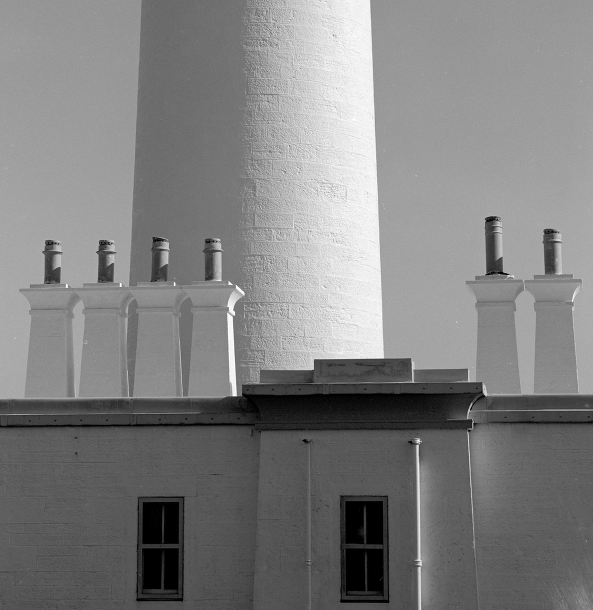
Covesea Lighthouse, Lossiemouth, Moray, Scotland FP4 Plus EI160 FX 3 1+1 6 minutes Ilford agitation 20C
FX 3 Formula
The FX 3 formula is primarily designed to be a fine grain, general purpose developer specifically formulated for smoother and finer grain than FX 1 and FX 2. Although a solvent developer, sharpness has been increased through reduced sulphite levels.
The developer is ideal for both portraits and landscapes at 1+1 dilution where it provides strong contrast, good sharpness, and a pleasant, long and smooth tonal range. However, it does not provide acutance and, because of this, micro-detail is not well supported.
This developer is suitable for fast films in 35mm or medium and slow films where greater enlargement is required.
A word of caution. As I mentioned above, FX 3 developer increases contrast quickly when developing so careful personal development time testing is essential to get the best and not cook the highlights. It’s very easy to over develop with FX 3 and I suspect many photographers have inadvertently done so in the past. I found my development time, for FP4 Plus shot at the measured film speed of EI 160, diluted 1+1 with water, was a rather brisk 6 minutes using Ilford agitation. Crawley stated a development time should be around 10% less than D-76 but I found it to be much shorter than that (as we will also find in FX 4). Don’t be surprised if you find your development times to be somewhat shorter than expected. Like all developers aim for grade 2 for medium format and grade 3 for 35mm.
Film speed and pushing
In the usual Crawley manner, there is a slight speed gain above box and I found an EI of 160 was delivered with FP4 Plus film for normal contrast printing (grade 2) with 120 film.
This would make a good pushing developer with nice, short development times. As I mentioned above, it proved itself rather active, and I suspect N+ development would be easy and produce good pictorial quality negatives, especially with the attractive highlights FX 3 can produce.
Tonality
Of particular interest is the tonality this film delivered in bright conditions. It is smooth and rich giving photographs a three dimensional look in bright sunshine. It made printing negatives in the darkroom easy and rewarding. FX 3 is one of those developers that not many photographers use and this “FX 3 look” could provide your work with a unique personality.
Metol allergy
This formula contains no metol and would be useful for photographers who might have, or be worried about, metol allergy.
Capacity
This developer has very good capacity when used as stock processing no less than 10-12 films per 1 Ltr. Just add 5% to development time for every film after the first.
Formula
| Chemical | Amount |
|---|---|
| Water 50C | 800ml |
| Sodium sulphite Anhy. | 75g |
| Hydroquinone | 6g |
| Phenidone | 0.25g |
| Borax | 2.5g |
| Potassium bromide | 1g |
| Water to make | 1 Ltr |
- Fully dissolve each chemical in the order given.
- The hydroquinone dissolved before the phenidone will stop oxidation and regenerate any previously oxidised phenidone helping it to dissolve - a useful tip.
- Borax can be stubborn to dissolve but will go into solution with some judicious crushing and stirring.
- Use at a dilution of 1+3 for best results with tabular grain films.
Longevity
FX 3 should last at least 6 months in a stoppered bottle but Crawley noted that it can increase in activity over time. This is just like the D-76 original formula did and seems to be due to an increases in alkalinity. Therefore, if you are not going to use it within a few months it’s easier to make it as required. Below is the formula to make 250ml stock solution. Enough to develop a 120 film at 1+1 dilution. If you like to use the developer as stock then double the amounts below:
| Chemical | Amount to make 250ml stock |
|---|---|
| Water 50C | 200ml |
| Sodium sulphite Anhy. | 18.7g |
| Hydroquinone | 1.5g |
| Phenidone | 0.06g (6ml 1% soln.) |
| Borax | 0.6g |
| Potassium bromide | 0.25g |
| Water to make | 250ml |
- Dilute 1+1 to make a total 500ml for one 120 film.
Ilford Development times
These times will give you a starting point for your own development time testing. If you don’t use Ilford films then please extrapolate your own film times from these.
- Shoot at box speed plus 1/3 of a stop.
- Ilford agitation.
- All developed at 20C at dilution 1+1 dilution.
- Ilford FP4 Plus 1+1 6-7 minutes.
- Ilford HP5 Plus 1+1 7-8 minutes.
- Ilford PanF Plus 1+1 4:30-5 minutes.
Grain
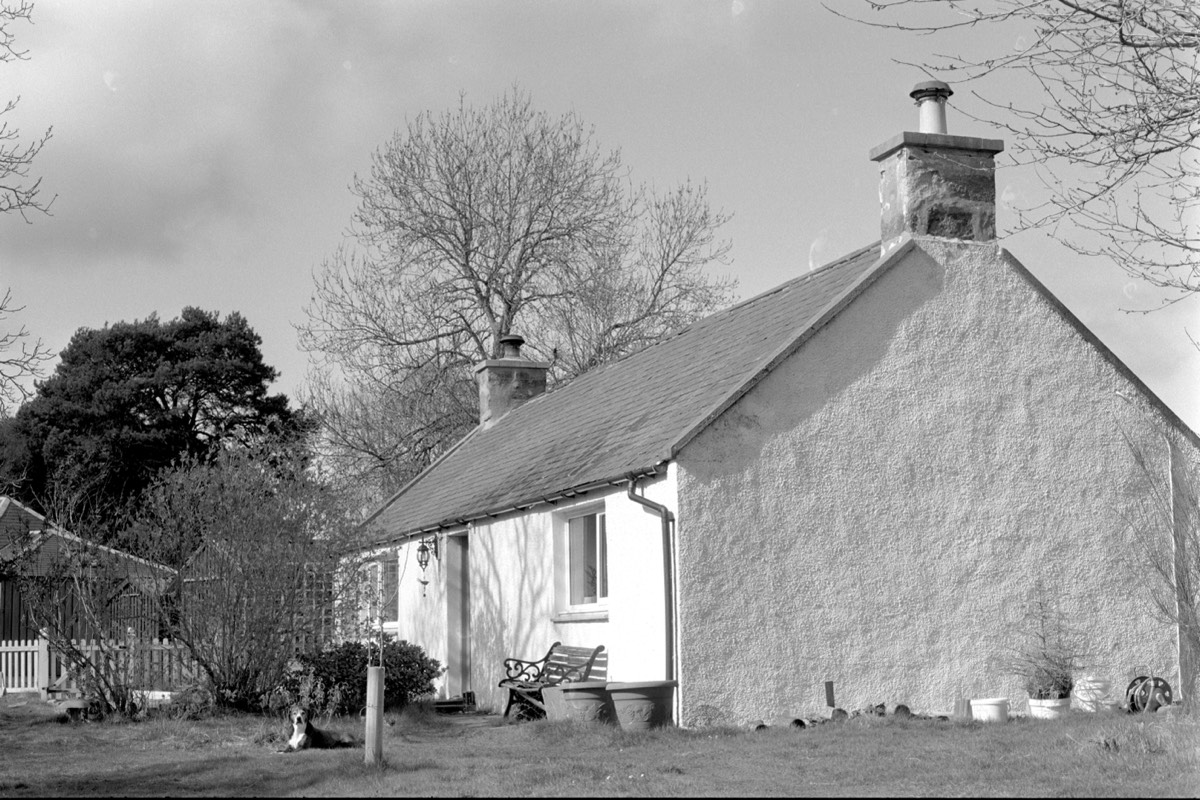

FX 3 grain with FP4 Plus in 35mm. Pentax MX with 50mm F1.4 lens. 100% enlargement of above scan showing grain and sharpness/detail.
Conclusion
Before I started this FX 3 test I didn’t know much about this developer. But having used it for a couple of weeks I find FX 3 stands out as a well engineered solvent developer that builds on the legacy of D-76 and MQ Borax while offering its own distinctive advantages and quality. By carefully balancing the developer constituents, Crawley has formulated a smooth, tonally rich developer that enhances sharpness. It’s a quality general purpose developer, suitable for both portrait and landscape photography with all film speeds. Its design avoids metol, benefitting those with skin sensitivities, and offers very good capacity for multiple films if used as stock. While I believe it requires precise personal development times, to prevent overdevelopment and preserve highlight detail, I found FX 3 rewards careful technique with negatives that are easy to print and possess a unique, almost three-dimensional character. For those of us seeking a developer that combines fine grain and pleasing tonal gradation, with perhaps a “look” that’s a little different from the mainstream developers, FX 3 is a compelling choice.